

How a Composer and Geoscientist Sees the Arctic

An edited conversation with Isabelle Ryder about Greenland, glaciers, geology and the music of the Arctic.
Introduction
At Sarasota Cruise Agency & DeSalvio Travel, we believe that understanding a destination changes the way we experience it. For me, that has a particular connection with music. As a concert pianist and travel professional, I know how music can prepare us to listen to a place: to notice movement, texture, silence, rhythm and scale. That is especially true in the Arctic, where landscapes that appear still are constantly moving and changing.
In September 2023, an enormous rock-ice avalanche entered Greenland's Dickson Fjord. Around 25 million cubic metres of material, roughly the volume of 25 Empire State Buildings, plunged into the fjord. The impact generated an estimated 600-feet-high tsunami. The water then settled into a long-lasting standing wave, or seiche, that continued oscillating for nine days and produced a seismic signal detectable around the world.
Isabelle Ryder, a geoscientist, had a particularly unusual connection to the event. She had previously travelled through Dickson Fjord and brings together two perspectives rarely found in the same person: scientific experience in the Arctic and a career as a composer and pianist. She has worked as a field assistant on geological mapping expeditions, later studied the movement of the Earth's surface through geodesy, and travelled hundreds of kilometres through remote Greenlandic terrain and fjords. Those experiences have become the raw material for her music.

Her Fjord Suite does not simply attempt to make music that sounds "Arctic." Its movements come from specific encounters with ice, wildlife, geological material, expedition history and the physical forces of the landscape. We spoke about what happens when someone who understands the science also begins to hear the landscape as a composer.
The Interview
You first experienced Greenland through scientific fieldwork. What were you actually doing there?
I was invited to work as a field assistant for the Cambridge Arctic Shelf Program. I wasn't a CASP scientist, but I worked with the team in the field. The job involved trekking long distances and looking for sandstones, mudstones and occasional fossils that could be used for geological mapping. The scientists were trying to understand the geology on the Greenland side and how it related to the geology of Norway.
It was very physical work. You spend a lot of time walking through an enormous landscape, but you are also looking very closely at what is under your feet.
You later worked as Geoscientist in geodesy and earthquakes. Did that change how you saw landscapes?
Yes. Geodesy is essentially the study of the shape of the Earth. Later I worked with radar imagery to map ground movement associated with earthquakes. I'm not a seismologist, and I don't have detailed training in analysing seismic traces, but I understand the language and the physical processes.
That became particularly relevant when the event in Dickson Fjord happened, because I had actually been there. I could connect the scientific description of the event with a landscape I knew.

You also had another extraordinary Greenland experience involving a glaciology expedition.
Yes. A group of students had been doing a glaciology expedition and had been out for about a month, carrying heavy loads and collecting measurements. They reached their depot about a day earlier than planned because they had run out of food, so we had to make haste to collect them. We travelled about 180 kilometres (111 miles) in small outboard motor boats to reach them.
That journey reminded me how remote these places really are. You can have an expedition with a carefully planned schedule, but once you are in the Arctic, circumstances can change very quickly.
Then came the avalanche in Dickson Fjord. What first caught your attention about the 2023 event?
A former PhD student, Stephen Hicks, contacted me because he knew I had travelled up the same fjord. He was working as a seismologist and told me about this extraordinary event. What interested me was the periodicity of it.
The avalanche pushed an enormous amount of material into the fjord, displacing water. Because the fjord is narrow and has very high walls, the water began moving back and forth, rather like water sloshing in a bath. That created a standing wave, or seiche, which continued for about nine days.
And that became music?
Yes. I wanted to reflect the periodic movement of the water. The piano figure in the piece is based on the idea of a sine wave. I was essentially trying to make a musical version of that oscillation. Around that figure, the overall musical soundscape is intended to give a feeling of vastness, breadth, and depth.
I also created a Google Earth fly-through of the route we had travelled through the fjord, moving slowly through the landscape with the music accompanying it. The idea was to connect the physical landscape, the scientific event and the music.
From Science to Music
Your Fjord Suite grew out of travel experiences more broadly. How did that happen?
I had been encouraged by Stephen Pratt to use my travels as the starting point for more of my classical music. I'd previously written songs about things I had experienced, including earthquakes in Chile, but I wanted to bring those ideas into classical composition.
I had started sketching things from different journeys, including an early idea about ice in the north. That led me back to Greenland. I had also been thinking for some time about dolphins and seals I had seen in the wild. I wanted water to become part of the piano texture, and when the animals jumped out of the water, I imagined the hands crossing over each other.
So there is a very visual element to the way I compose.
You also researched the physical structure of ice. How much science actually makes it into the music?
Quite a lot goes into the initial thinking. I looked at the structure of ice, hydrogen and oxygen bond lengths and even hexagonal close packing. Mathematical ratios of bond lengths did actually become the starting point for the rhythms of one of the pieces.
But once a piece is started, usually the mathematics takes a second seat to expression and purely musical development. I don't want the music to sound as though I have simply converted a scientific diagram into notes.
Irregular rhythms are a hallmark of much of my music in any case. I use things like 5/8, 7/8 and 11/8 quite naturally because I like disruptive rhythms. Some of the rhythmic character also came from listening to Bela Bartók.
Five Arctic Stories
Race Against Ice is perhaps the most dramatic movement. What happened?
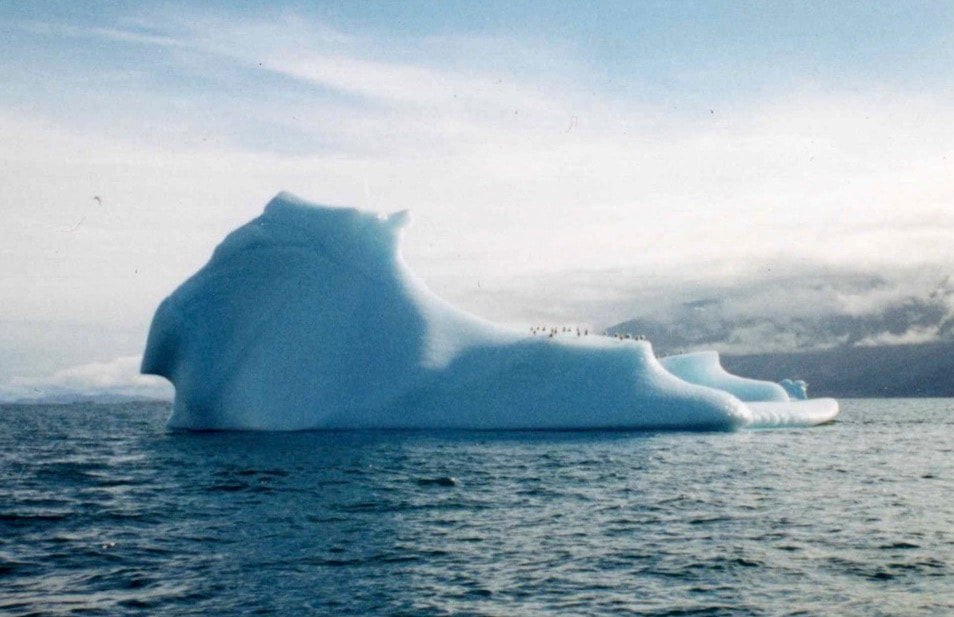
We were approaching the final destination when we saw a huge, blocky iceberg. It was roughly the size of several houses and it began to look unstable. Pieces were breaking off, so we realised we needed to reach the shore.
We made it, and about five minutes later the iceberg disintegrated. Pieces broke away and a wave travelled towards the shore. If we had still been in the boat, we could have ended up in a very cold fjord.
That is the idea behind Race Against Ice. It has a Mission Impossible quality to it, and I really want it played fast. The tempo is important because the music is about that race against the instability of the ice.
Garnet Blessing is much more intimate.
When we were preparing for the journey, a Danish couple came onto the jetty carrying a large garnet crystal. I asked them what it was, and they told me they had found it themselves. They let me hold it as a blessing for a safe journey.
Then, not long afterwards, we had the iceberg incident. So perhaps it really was a blessing. The movement is my musical response to that small human encounter in the middle of this enormous landscape.
What is behind Spirits of Ella Island?
During the long journey we stayed in small huts used by hunters and scientific expeditions. We stayed on Ella Island, where people had been coming and going for decades. You could feel the history of the place. You could imagine all the different people who had spent nights there before us.
It was a small, rocky island and the day was grey and misty. The "spirits" aren't literal. They are the sense of all those previous people being present in your imagination. The swirling sounds in the music are the mist.
And Ancient Blue?
The blue is the blue of glacial ice. The movement has descending lines and very slow motion, representing the ice gradually moving downwards.
I deliberately used an older, contrapuntal musical style because the ice itself can be ancient. I wanted something that conveyed that sense of age and almost sacredness.
Finally, Seal Highway.
That is the playful one. We saw seals resting on icebergs while we were travelling through the fjord. Later, when we stopped at one of the huts, we walked along the coast and a bearded seal appeared.
The piano has a watery quality, and I think of the movement as having an ice-cold shimmer. There can be quite a lot of flexibility in the performance. The rubato can move around, as long as you keep that sense of sparkle.

The Arctic Beyond Greenland
Greenland is not your only Arctic musical landscape. What happened when you travelled to Arctic Norway?
I also travelled to northern Norway and led an expedition into the Lyngen Alps. We spent some time in Tromsø and linked up with students at the University of Tromsø before going into the mountains.
While we were in Tromsø, we saw the Northern Lights. That was another experience that immediately suggested music to me. I wrote a piano piece called Aurora, which is essentially an étude inspired by seeing the Northern Lights.
It is somewhat similar in conception to a Chopin étude. The idea isn't to make a literal musical representation of the aurora, but to take the experience of seeing the shifting colours and turn that into a musical language.
So the Arctic has continued to give me different kinds of musical material. Greenland gave me the Fjord Suite, with its ice, water, wildlife and geological stories, while the Northern Lights led to something more abstract and étude-like.
How a Composer and Scientist Sees the Arctic
You have experienced the Arctic as a scientist, a fieldworker and a musician. Does that change what you notice?
I think it means I notice the landscape on several levels. Scientifically, I am thinking about the geology, the movement of the ice, the shape of the fjords and the processes taking place around me. But I am also seeing things visually and thinking about how they could become sound.
An iceberg can become rhythm. The movement of a glacier can become a descending musical line. Water can become texture. Mist can become something swirling. Even the history of a hut can become part of the atmosphere of a piece.
The Arctic can look very still, but it isn't still. Ice is moving. Water is moving. Mountains are changing. Animals are moving through the landscape. That physical movement is something I try to capture in the music.
What should travelers understand before going into such environments?
The Arctic is a place where you need to take the environment seriously. There are obvious risks, such as polar bears, but there are also geological and environmental hazards that aren't necessarily visible.
Due diligence is important. You should understand the environment you are entering, the risks involved and how those risks are being managed. And I would certainly not recommend going into remote Arctic environments on your own.
The remoteness is part of what makes these landscapes extraordinary, but it also means that you have to respect them.

What do you hope someone takes away from hearing your music after experiencing the Arctic?
I would like them to hear the physicality of the landscape. The landscape itself has a history that goes far beyond what we can see in a single moment. In addition, I aim to capture the feeling of space and openness that one feels intensely in the Arctic.
A Landscape in Motion
What I find most compelling about Isabelle's work is that the music does not ask us to choose between science and art.
The science tells us what happened in Dickson Fjord: 25 million cubic metres of rock and ice entered the water, generating a 600-feet tsunami before the displaced water settled into a much longer-lasting seiche. The physics explains how a fjord could continue to oscillate for nine days and produce a seismic signal detectable around the world Isabelle's music begins somewhere else. It seeks to reimagine both the event and its environment, in a unique sound-world.
That distinction is important in expedition travel. A glacier is not simply scenery, and a fjord is not simply a beautiful place to photograph. The landscape has structure, memory and physical processes that continue whether or not we notice them.
For me, that is where music has a particularly interesting role. It can bring another dimension to the experience without pretending to replace scientific understanding.
A composer who is also trained to read the Earth sees the Arctic as both landscape and process: ice descending through time, water moving through confined space, wildlife appearing among bergs, mist moving across an old expedition island, the Northern Lights transforming the night sky, and a seemingly quiet landscape capable of extraordinary physical force. That is a compelling way to enter the Arctic before ever stepping ashore.
For more information about Isabelle:
Listen here to our Arctic and Scandinavian Playlist with my recordings:


Comments