

Who Lives in the Arctic?

Updated: Oct 7
The Arctic is not one community, and there is no single Arctic way of life. Inuit communities span Alaska, Canada, Greenland and Chukotka, while the Sámi live across parts of Norway, Sweden, Finland and Russia. Their languages, histories, traditions and political circumstances are different. The Inuit Circumpolar Council represents Inuit across four countries and describes Indigenous Knowledge as knowledge developed through generations of experience and observation, while continuing to evolve today.¹
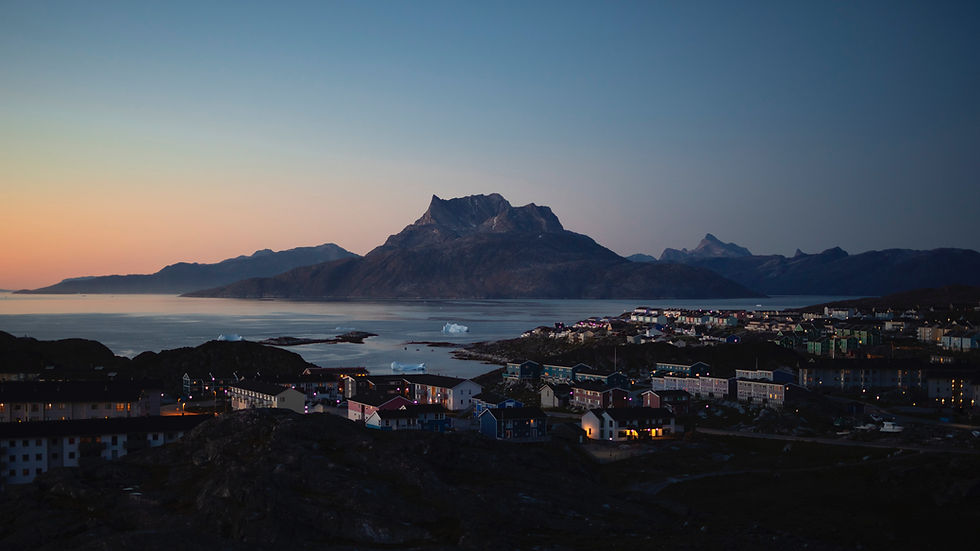
For a traveler, this matters because Arctic communities should never be treated as part of the scenery. These are contemporary societies, not remnants of a historical Arctic. At the same time, understanding how people have lived in the region for centuries and many generations can completely change how we understand the landscape. The ice, animals, weather and seasons are not simply things to look at. They have shaped where people live, how they travel and how they understand their surroundings.
Two Very Different Ways of Living
The historical encounters between European explorers and Inuit communities show just how different these worlds could be.
When Nansen crossed Greenland in 1888, he encountered Inuit families living in temporary skin tents, travelling by kayak and using seal-oil lamps. He was struck by how differently the two groups lived, but also recognised that his own customs were just as unfamiliar to the people he encountered. His account is particularly interesting because he understood that European habits were not automatically the standard by which Inuit life should be judged.²
For explorers arriving from Europe or North America, the Arctic could seem almost impossible to inhabit. For Inuit communities, it was home. Knowledge of sea ice, weather, animals, clothing, sledges, boats and seasonal movement had been developed through generations. The difference was therefore not simply cultural. It was practical. An explorer could arrive with advanced instruments and a large expedition behind him and still lack the knowledge needed to survive locally.

Robert Peary eventually built much of his Arctic travelling method around Inuit practices. He adopted fur clothing, boots, igloos and sled dogs and recognised that Inuit equipment had been tested by generations of experience. In his own description of the “Peary System,” he stated that Inuit formed the rank and file of his sledging and hunting parties, built his sledges and dog harnesses, and made the fur clothing essential to his expeditions.³
This is an important part of polar exploration history. The explorers whose names appear in the history books were often dependent on people whose names were barely recorded and I dare to say that I am not sure Peary would have made the North Pole without the adaptation of local practices.
When Explorers Needed the People Who Already Knew the Arctic
The dependence became even clearer when expeditions went wrong.
During Elisha Kent Kane's search for Franklin in the 1850s, his expedition became trapped in Greenland. The men faced severe shortages of food and fuel, and members of the expedition eventually depended on local Smith Sound Inuit for seal meat and walrus. Their assistance helped keep the stranded expedition alive.⁴
This pattern appears repeatedly in the history of Arctic exploration. Inuit provided food, clothing, dogs, hunting knowledge, transportation and practical knowledge of the environment. Explorers learned how to travel across sea ice and snow, how to dress for the cold and how to make use of materials available locally. Inuit women prepared clothing and sleeping bags for Peary's expeditions, including the extraordinarily demanding process of chewing deerskins to make them pliable enough to sew.⁵
The relationship was not always equal or respectful, and that history also needs to be acknowledged. Peary's writings contain both strong admiration for Inuit abilities and deeply paternalistic descriptions of Inuit society. His own account makes the contradiction particularly clear: he considered Inuit indispensable to his expeditions while also describing them through the assumptions of his own era.³
After Peary it was Knud Rasmussen who started researching the Inuit cultures. Through his extensive travel he realised that there were linguistic correlations between different communities and started collecting local stories, traditional songs, rituals and myth, like Bartok or Kodaly would do in Hungary and Romania

The Arctic Is Lived In
This is also why historical accounts need to be handled carefully. Nineteenth-century European observers often described Inuit life through European assumptions about clothing, food, religion, family and social organisation. Those observations tell us something about the observers, but they should not automatically be treated as objective descriptions of Inuit culture.
Hinrich Johannes Rink provides an interesting example. The Danish official worked in Greenland during the nineteenth century, collected Inuit oral traditions and worked on an Inuit-Danish dictionary. His writings also recorded the spiritual significance that the inland ice could have within Greenlandic traditions. He described a strong sense of awe surrounding the ice and recorded stories associated with nunataks and beings connected with the inland ice.⁶
Rink's account is valuable as a historical record, but it should be presented as a nineteenth-century European recording of Greenlandic traditions rather than as a definitive description of what all Inuit believed.
The history of Greenland itself also reminds us that Arctic societies have never been static. Groups of Inuit settlers arrived in Greenland from northern Canada around the twelfth or thirteenth century, while the Norse Greenland settlements developed alongside them. By the fifteenth century, the Norse presence had disappeared, while Inuit communities continued to live in Greenland.⁷
The Arctic is therefore not a museum of traditional life. Inuit communities are modern communities with contemporary economies, technology, politics, education and art, while Indigenous knowledge continues to develop as a living body of knowledge.¹

Meeting Arctic Communities With Respect
At DeSalvio Travel and Sarasota Cruise Agency we have a strong believe that the best experiences are made by the connection between locals and travelers. When we plan an Arctic journey, we look for experiences where local people are genuinely part of the experience rather than simply presented as an attraction. Who is telling the story? Where does the knowledge come from? Is the experience connected to the community itself?
Food, art, storytelling and local guiding can all provide a more direct understanding of a place, but the most important thing is to listen. The historical record shows how much European explorers had to learn from people who already knew the Arctic. Modern travelers have an opportunity to approach that relationship differently: not by treating Indigenous knowledge as a tool for their own journey, but by recognising the people who have carried that knowledge for generations, sharing, learning and taking an experience back home that they won't forget.
You May Also Enjoy
Planning an Arctic Journey
The most meaningful Arctic experiences often include time with people who actually live there. We can help identify journeys where local communities, guides, artists, historians and Indigenous perspectives are genuinely part of the experience. The aim is not simply to see the Arctic, but to understand whose homeland you are visiting and why the landscape means something different to the people who live there.
The Arctic is about far more than reaching a remote destination. Explore our broader approach to Expedition Travel.
Footnotes
Inuit Circumpolar Council, “Inuit Knowledge.”
Fridtjof Nansen, The First Crossing of Greenland, chapter 2.
Robert Peary, “The Peary System,” as quoted in Jon Gertner, The Ice at the End of the World, chapter 1.
Elisha Kent Kane, account of the Franklin expedition, as quoted in The Greatest Polar Exploration Stories Ever Told, “In Search for Franklin.”
Jon Gertner, The Ice at the End of the World, chapter 1.
Hinrich Johannes Rink, Danish Greenland, Its People and Its Products, 1877.
Jon Gertner, The Ice at the End of the World, chapter 1.


Comments